2026/3/12
Design That Advances Vision
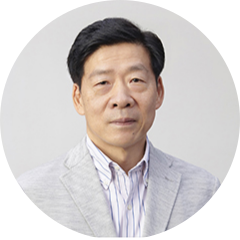
In accepting the role of Chairperson of the GOOD DESIGN AWARD Judging Committee, I found myself once again reflecting on a fundamental question: What is good design? In my own understanding, two primary requirements come to mind.
The first is whether it is instinctively perceived as beautiful. A form, presence, or usability that intuitively draws people in. This beauty must not be mere decoration, but rather a beauty that embodies function and rationality.
The second is whether it possesses social relevance. Beyond environmental considerations, how does the design relate to society—its human rights, labor practices, logistics, and industrial structures? Design is always part of society and inherently reflects a stance toward it.
These two conditions may represent what we currently share as the core criteria for good design. Yet I feel that these alone may not be sufficient.
The third requirement is whether the design advances a vision. That is, whether it connects an organization’s reason for being with its concrete business activities. If the underlying vision differs, shouldn’t the ideal design also be different? Design connects vision, worldview, and product into a coherent whole, and in doing so serves as a form of communication that fosters deep understanding for users.
Has the process for evaluating designs been sufficiently informed by this perspective to date? I believe it has not. Moreover, this challenge cannot be resolved by design alone. The business side must first articulate a clear and highly resolved vision. Only through collaboration between business and creative teams can this issue be fundamentally overcome.
I hope the GOOD DESIGN AWARD will become a platform not only for those involved in design, but a place where business and creative professionals engage in dialogue and collaboration. I also hope applicants will use the opportunity presented by the GOOD DESIGN AWARD to reconsider what their organization’s ideal form, indeed, their vision, should be.
2026/3/12
Shaping through Inquiry
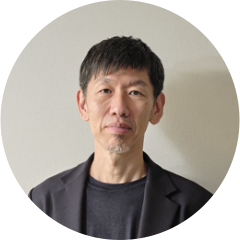
The present in which we live exists within a continuum linking past and future. Building upon the many layers of inquiry that have come before, how can we sustain our creative endeavors moving forward? As the role of design grows broader and deeper, I have a keen appreciation of the importance of offering thoughtful and proactive proposals for the future.
In recent years, accumulated experience has increasingly enabled clear paths to solutions to emerge swiftly. Yet creative thinking and activity for people and society cannot easily be confined within fixed frameworks. Important insights often lie in situations where immediate answers are elusive, and they should not be overlooked.
This is precisely why I want to focus on how each organization and individual, drawing upon their own position and expertise as strengths, expand insight from immediate subjects to broader contexts, allowing the steady and powerful continuation of such efforts to give shape to environments and businesses in meaningful ways.
Design also plays a vital role in forging flexible connections between individual circumstances and different domains. Through ongoing dialogue among the many stakeholders involved in projects, how can we shape our surrounding environment with an integrated perspective? Equally important are the passion and courage to communicate the backgrounds and processes that support these efforts.
I hope to see far-ranging possibilities of design emerge, through dynamic activities that unite a vision for society’s future, logical thinking that advances intention, the sensibilities of contemporary citizens, and a perspective grounded in business. And I look forward to encountering many of you through this year’s GOOD DESIGN AWARD.
2026/3/12
Beautiful Form
Design is the act of creating beautiful form within a chaotic society. Here, ‘form’ does not refer solely to physical shape. It also encompasses states in which dispersed elements such as regions, businesses, and ways of living are connected, given definition, and brought into being as a tangible and coherent order that we can truly feel.
Ironically, many of the challenges society faces today are the result of accumulated local optimizations driven by beliefs in rationality and efficiency within individual contexts. Correctness is a powerful standard, but, as the fallacy of composition tells us, adding together individually correct decisions can often produce outcomes that are problematic for the whole. Environmental issues and social division are not necessarily born of malice. They can also result from the accumulation of well-intentioned and individually correct choices.
By contrast, beauty resides in a state where relationships among elements are harmonized and the whole functions effortlessly. It is not merely the balance of colors or shapes. It is also the capacity to embrace conflicting values (individual passion and organizational vision, business viability and on-the-ground urgency, local concerns and global challenges) while maintaining equilibrium without collapse, even amid imperfection. It is in this totality and harmony that we instinctively perceive beauty.
Today, we need to move beyond measurable correctness, and engage with the quality of harmony that lies beyond measurement: what we call beauty. When you hear the word beauty, you might instinctively resist, thinking of it as something subjective. But the pursuit of beautiful form is not simply aesthetic preference. It is an attitude of carefully weaving supple order into society while embracing contradiction. This applies equally to the design of things and the design of systems and experiences. Design is being asked to serve as the intelligence that reintegrates fragmented correctness into a coherent whole. I sincerely hope to encounter tangible beautiful forms that transcend disciplines.
2026/3/12
Design as an Illumination of Imagination
Objects that have quietly existed over time. Systems that have gradually connected people. Can these truly be spoken of separately? When we look at society, we find that objects and systems are designed in an intertwined manner. Objects give rise to systems; systems give rise to objects. Before design takes shape, countless individuals and organizations devote time and thought to those who will ultimately engage with what they create. Layer upon layer of trial and error has quietly supported our social life.
For 70 years, the GOOD DESIGN AWARD has developed alongside the economic activities of people living in Japan, reflecting with applicants on what design is and communicating that understanding. Yet in our rapidly changing society, are there things we are overlooking? Things that have become invisible? I would like to turn attention to creations born from small, easily overlooked considerations, and to systems that quietly connect people. In recent years, Grand Prize-winning projects have demonstrated with increasing clarity the essential perspective of “being designed for someone.” In an age marked by division and anxiety, it is vital to imagine not only the neighbor before us, but also someone yet unseen. This capacity for imagination may be described as one of the core competencies of those engaged in design.
Going forward, I believe the role of the GOOD DESIGN AWARD is to pause and reflect on what design can and cannot do today, to cultivate connections among applicants, and to serve as a bridge that reconnects people. Through such new challenges, I hope we will look on the society of the future and encounter emerging signs of new economic activities already beginning to take root. All of us on the Judging Committee look forward to designs that illuminate new imagination between people.